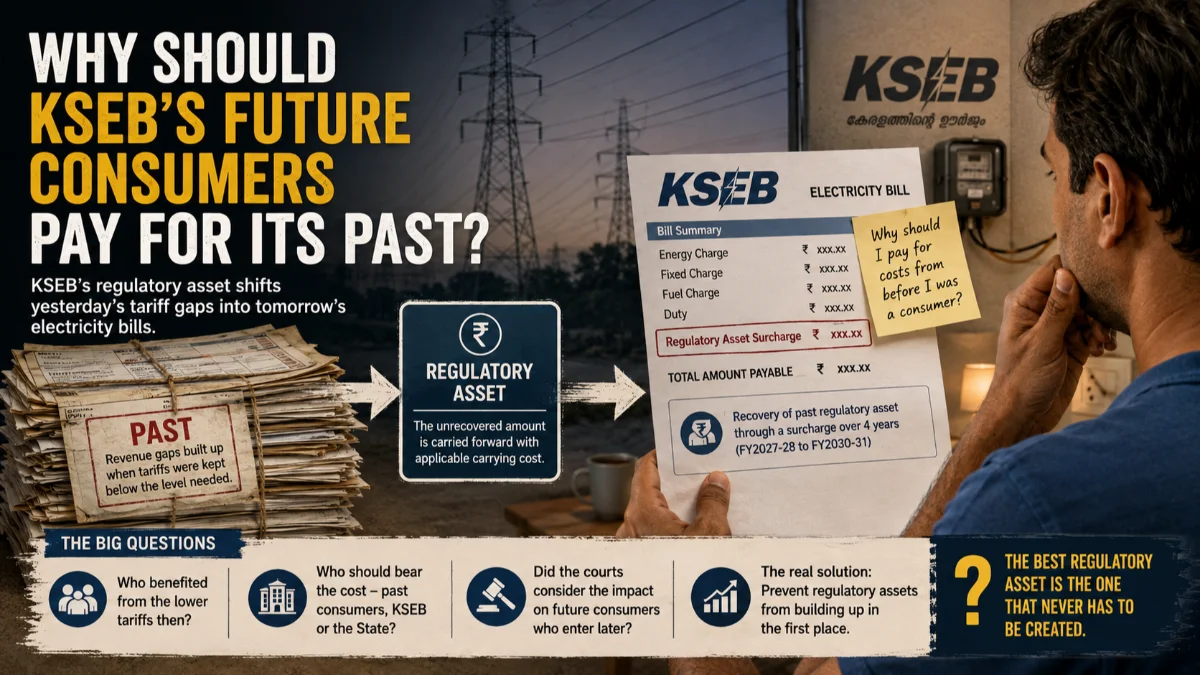
KOCHI: Imagine getting an electricity bill for costs incurred years before you became a KSEB consumer.
That is essentially the question raised by KSERC's proposal to recover KSEB's past revenue gaps from consumers in the coming years.
KSEB had, over the years, incurred costs that it was not allowed to recover fully through tariffs at the time. Instead of passing the entire burden on to consumers immediately — which could have resulted in a sharp tariff increase — the unrecovered amount was carried forward for recovery later in order to avoid 'tariff shocks'.
This is where a rather technical term enters the picture: regulatory asset.
In simple terms, it is money that KSEB was allowed to recover later rather than through the tariffs charged when the costs were originally incurred. The amount therefore becomes an asset in the utility's regulatory accounts, even though it is not an asset that can be seen or touched like a power plant or transmission line.
Now KSERC proposes to bring that old bill back into the electricity tariff system.
Draft multi-year tariff regulations
Under the draft Multi-year Tariff Regulations for 2027-28 to 2031-32, the regulatory asset existing as of March 31, 2024, along with carrying cost, is proposed to be recovered through a Regulatory Asset Surcharge in four equal instalments from 2027-28 to 2030-31.
And that raises the uncomfortable question:
Should consumers who are paying electricity bills today — or who become KSEB consumers tomorrow — have to help clear a revenue gap created by tariff decisions made years ago?
There is a counterargument too. The earlier decision to defer recovery has protected consumers from a sudden tariff shock. The money was not written off; its recovery was merely postponed to a later period.
But postponement creates a different problem.
Is it fair?
The consumers who benefited from lower tariffs in the past may not be the same consumers who pay the surcharge in the future.
That makes the issue more than an accounting exercise. It becomes a question of fairness between generations of consumers.
And there is a second question for the regulator: if consumers are now being asked to clear an old revenue gap, what safeguards will ensure that another such gap does not accumulate and become tomorrow's bill?
KSERC says the new tariff framework is intended to improve efficiency and accountability, including by replacing the existing flat escalation approach for KSEB's operation and maintenance costs with a normative, benchmark-based methodology linked to business growth and actual CPI/WPI indices.
So the real issue is not simply whether KSEB should recover money that it was legitimately denied earlier.
It is who should pay, how much should be paid, and whether today's consumers should inherit yesterday's electricity bill.