KOCHI: After spending nearly a decade cleaning up bad loans, Indian banks are confronting a new challenge that could define the next phase of the industry's growth.
The problem is no longer finding borrowers but mobilising enough deposits to fund healthy credit demand without eroding profitability.
The shift is evident in the banking system itself. Credit growth has continued to outpace deposit growth, pushing the banking system's credit-deposit (CD) ratio above 82 per cent—its highest level in more than a decade.
As the funding gap widens, banks have increasingly relied on wholesale funding, particularly certificates of deposit (CDs), to supplement traditional deposits.
The growing dependence on market borrowings underlines a structural change in Indian banking.
For years, lenders struggled with stressed assets and mounting non-performing loans (NPLs). Today, with asset quality improving across the sector, liability mobilisation is emerging as the principal constraint on balance-sheet expansion.
Deposit accretion drags loan growth
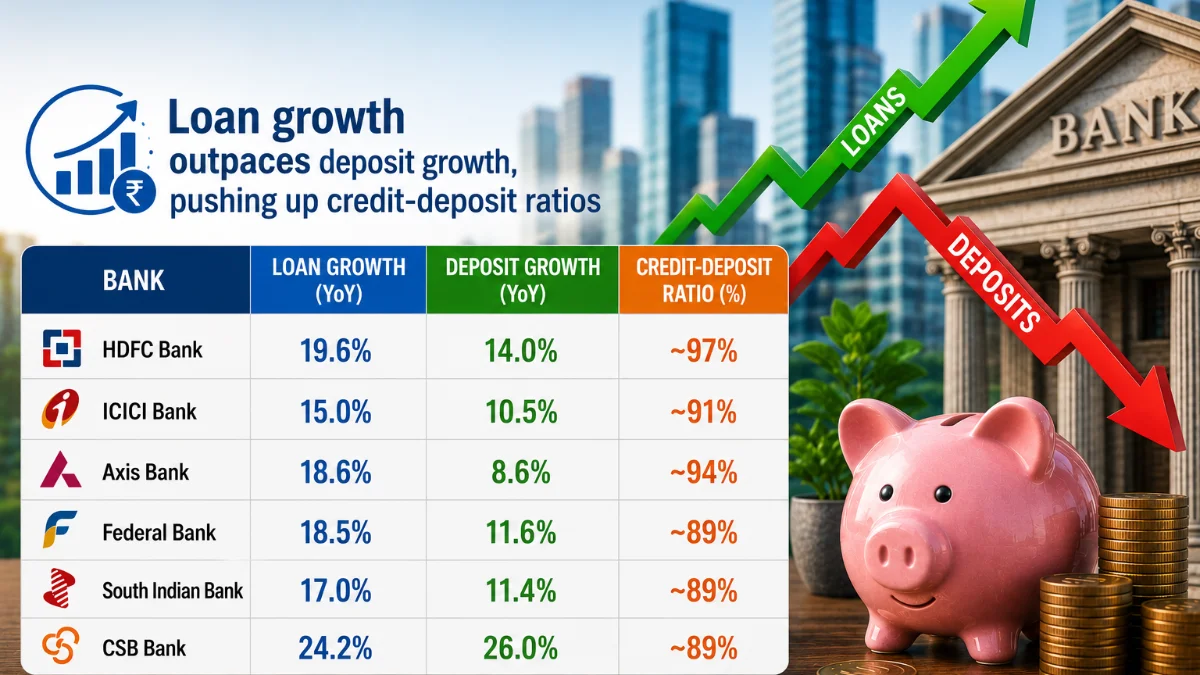
CARE Ratings recently warned that the elevated credit-deposit ratio (CD ratio)has become a structural concern for the banking sector and could eventually constrain credit growth unless deposit mobilisation improves. The rating agency noted that while loan demand has remained resilient, deposit accretion has failed to keep pace, forcing banks to increasingly depend on alternative funding sources.
The challenge is visible across both large and mid-sized private-sector banks. HDFC Bank, India's largest private lender, has publicly identified improving its loan-deposit ratio as a strategic priority following its merger with HDFC Ltd. Although the bank has made progress, management continues to emphasise deposit mobilisation as a key focus area even as credit demand remains healthy.
Irrespective of the size or scale, most private banks are facing a similar balancing act. Whether they be large banks such as HDFC Bank, ICICI Bank and Axis Bank, or Kerala-based banks like SIB, CSB Bank or ESAF Bank, the biggest chalenge before them now is not about tackling bad loans, but rather how to raise deposits in order to feed the increasing demand of credit from the market.
South Indian Bank (SIB), in its June-quarter earnings call, said deposit repricing following the RBI's rate cuts was beginning to ease funding costs while reaffirming its focus on strengthening the retail deposit franchise. The comments reflect a broader industry trend where banks are placing increasing emphasis on liability growth alongside credit expansion.
Challenge persists
The challenge has become more complex after successive RBI repo-rate cuts. Lending rates linked to external benchmarks adjust downward almost immediately, compressing yields on advances, while deposit costs generally decline more gradually. The result is pressure on net interest margins precisely at a time when banks are competing more aggressively for deposits.
Industry observers say banks are increasingly left with three difficult choices: offer higher deposit rates and sacrifice margins, moderate loan growth to remain within comfortable funding levels, or raise a larger share of funds through wholesale markets. None of these options is ideal, underscoring why deposits have become the defining strategic issue for the sector.
Ironically, just as Indian banks appear to have emerged from the bad-loan cycle that dominated the past decade, they are entering another phase where liabilities, rather than assets, may determine the pace of growth.
In the years ahead, the success of banks may depend less on how fast they can lend and more on how effectively they can mobilise stable, low-cost deposits.