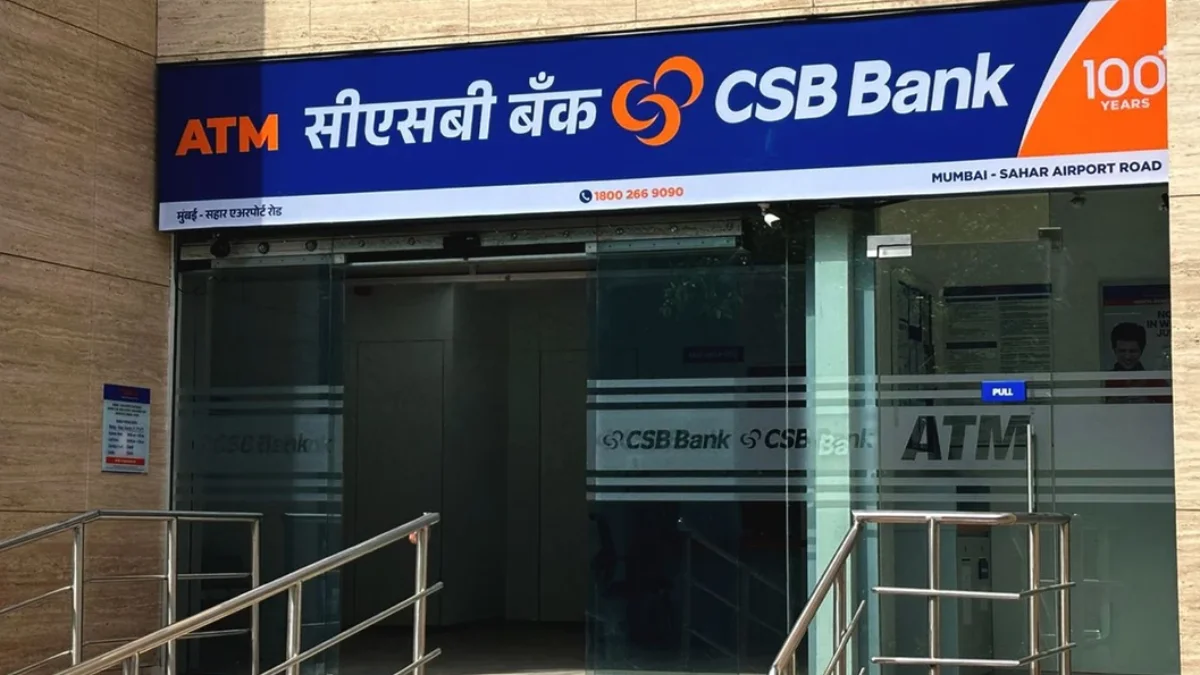
KOCHI: Gold seems to be doing the heavy lifting at CSB Bank’s loan growth. The bank's gross advances grew 22 per cent in the year to September, but gold loans grew much faster, by 36 per cent.
In fact, gold alone accounted for nearly three-fourths of the Rs7,661-crore increase in the bank's gross advances during the year.
Gold advances rose from Rs16,456 crore in September 2025 to Rs22,301 crore by September 2026. That means the Rs5,845-crore increase in gold loans accounted for about 76 per cent of the Rs7,661-crore increase in total gross advances.
Gold now accounts for nearly 53 per cent of CSB Bank's gross advances, compared with about 47 per cent a year ago.
In other words, more than half of CSB Bank's loan book is now riding on gold.
The question is whether this is simply a reflection of the bank's traditional strength in gold lending or whether gold is increasingly becoming the main engine of its credit growth.
CSB's gross advances stood at Rs42,373 crore at the end of September, up from Rs34,712 crore a year earlier. Deposits, meanwhile, grew 18 per cent to Rs46,889 crore.
ESAF Bank
If CSB's story is about gold, ESAF Small Finance Bank's September numbers point to a much broader push to rebuild its loan book.
ESAF's gross advances grew 25 per cent year-on-year to Rs23,931 crore. But the composition of growth is interesting. Retail and other loans grew 33.21 per cent to Rs15,600 crore, while micro loans grew only 12.19 per cent to Rs8,331 crore.
Its MARG portfolio — comprising MSME, agriculture, retail and gold loans — grew 38 per cent to Rs13,938 crore.
The bank is therefore pushing beyond its traditional microfinance-heavy base, with the faster growth coming from the broader retail and other-loan segments.
There is another number that needs to be kept in mind while looking at ESAF's growth.
The bank technically wrote off Rs625 crore of NPAs during the second quarter. It says that had the write-off not been done, year-on-year growth in gross advances would have been 28.32 per cent instead of 25.05 per cent. Gross advances would have stood at Rs24,556 crore.
ESAF's deposits, meanwhile, grew 24.34 per cent to Rs28,466 crore. But CASA grew only 9.91 per cent and the CASA ratio fell to 23.34 per cent from 26.41 per cent a year earlier.
SIB presents a different picture
SIB’s gross advances grew 18.67 per cent to Rs1,09,519 crore by September, while deposits grew almost exactly at the same pace — 18.70 per cent — to Rs1,37,258 crore.
CASA deposits grew 17.56 per cent to Rs43,310 crore, although the CASA ratio slipped marginally to 31.55 per cent from 31.86 per cent.
SIB, too, has a technical write-off in the background. The bank had written off Rs1,048 crore in the quarter ended March 2026. Without that write-off, it said the year-on-year growth in advances as of September would have been 19.81 per cent instead of 18.67 per cent.
So the three Kerala-based banks are growing, but the engines are quite different.
At CSB, gold is doing the heavy lifting. At ESAF, retail and other loans are growing much faster than the micro-loan book, with the broader MARG portfolio expanding 38 per cent.
And at South Indian Bank (SIB), advances and deposits are growing almost in tandem. The September numbers therefore tell us something more than how fast Kerala's banks are growing.