DUBAI: The United Arab Emirates cemented its standing as the Arab world's premier destination for foreign capital in 2025, attracting $48.2 billion in foreign direct investment — a figure that represents 40.4 per cent of total FDI inflows to the region.
The UAE's performance extended beyond raw capital attraction. The nation also claimed the top spot in the Arab world and 17th place globally in Dhaman's 2025 Composite Investment Climate Index, climbing two positions from its 2024 ranking — a signal that structural reforms and a maturing business environment are translating into measurable gains in investor confidence.
Despite the UAE's standout results, the broader Arab investment landscape told a more sobering story. Citing estimates from the United Nations Conference on Trade and Development (UNCTAD), Dhaman's report noted that FDI inflows to Arab countries declined by 10 per cent year-on-year, falling to $119.3 billion in 2025.
The distribution of those inflows was heavily skewed: more than 80 per cent of total FDI was absorbed by just three Arab countries. Meanwhile, the region's share of global FDI slipped to 7.3 per cent, and its share of FDI directed to developing economies narrowed to 13.3 per cent.
Compounding the picture, capital expenditure on FDI projects across the Arab world contracted by 9 per cent, dropping to $112 billion — a decline Dhaman attributed to geopolitical developments that weighed on investor sentiment and project execution timelines.
Investment climate rankings
The Composite Investment Climate Index offered a granular view of how Arab nations compare on the global stage. The average Arab ranking held steady at 102nd place globally, reflecting a persistent gap of roughly 23 places from the global average — even as 13 Arab countries managed to improve their individual standings within the index.
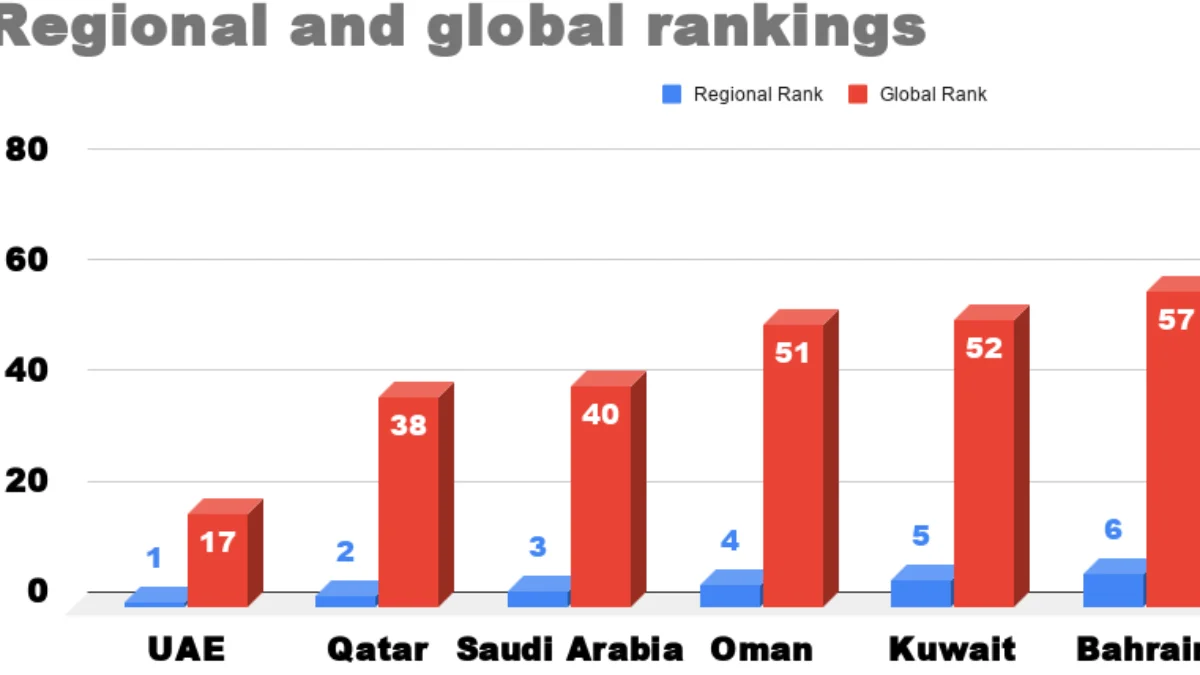
The Gulf Cooperation Council states, along with Jordan and Morocco, dominated the upper tier of the regional rankings:
Tunisia and Egypt also performed above the Arab average, placing 95th and 100th globally, respectively. However, the report noted that 11 other Arab countries languished near the bottom of the index, with rankings ranging from 104th to 158th — underscoring the deep disparities in investment readiness and business climate across the region.
Four pillars of reform
In response to the uneven landscape, Dhaman outlined an ambitious set of recommendations structured around four interconnected pillars, urging Arab governments to adopt integrated and flexible programmes capable of reshaping their investment environments.
Political and Security Environment
At the top of the agenda, Dhaman stressed the urgency of intensifying peaceful efforts to resolve ongoing conflicts and strengthening regional coordination to combat terrorism, organised crime, and external interference.
The report called for modernising security systems, de-escalating civil unrest, and reinforcing the rule of law — foundational conditions without which, it argued, even the most sophisticated economic reforms would struggle to attract sustained investor interest.
Digitisation
The second pillar focused on the architecture of governance. Dhaman recommended updating and simplifying investment and business laws to keep pace with evolving market realities, with a strong emphasis on digitising and automating procedures to reduce bureaucratic timelines.
The report also urged Arab states to strengthen governance and quality control systems, develop robust justice and law enforcement mechanisms, and protect investors through local legislation, international agreements, and advanced arbitration services — including the provision of insurance against both political and commercial risks.
Economic environment
On the macroeconomic front, the corporation called for policies to curb inflation and enhance currency stability, alongside reforms to tax and customs systems and continued investment in infrastructure and logistics. Crucially, Dhaman emphasised the need to empower the private sector and stimulate its participation by offering targeted benefits and incentives to priority industries — a recognition that state-led growth models are giving way to more collaborative approaches.
Production elements
The fourth pillar addressed the inputs that underpin long-term competitiveness. Key recommendations included: developing human capital and bridging the skills gap through education and training; increasing labour market flexibility; making industrial and service land accessible; diversifying and facilitating direct financing channels; and activating the role of banks and financial institutions.
The report further called for localising knowledge, stimulating research and development in production and service sectors, and securing local supply chains for intermediate inputs and essential components — all aimed at building resilience against external shocks.
Guiding principles for implementation
Beyond the four pillars, Dhaman offered several broad principles to guide reform efforts. Arab nations were encouraged to study the experiences of countries that have successfully improved their investment climates and climbed international rankings, while starting with the most straightforward and effective measures.
The report stressed the importance of leveraging technology and e-services, and cautioned against one-size-fits-all approaches — noting that countries differ significantly in resources, capabilities, and challenges.