KOCHI: Kerala is emerging as a key funding market for its home-grown banks, which mobilise a far larger share of their deposits in the state than the share of loans they deploy here.
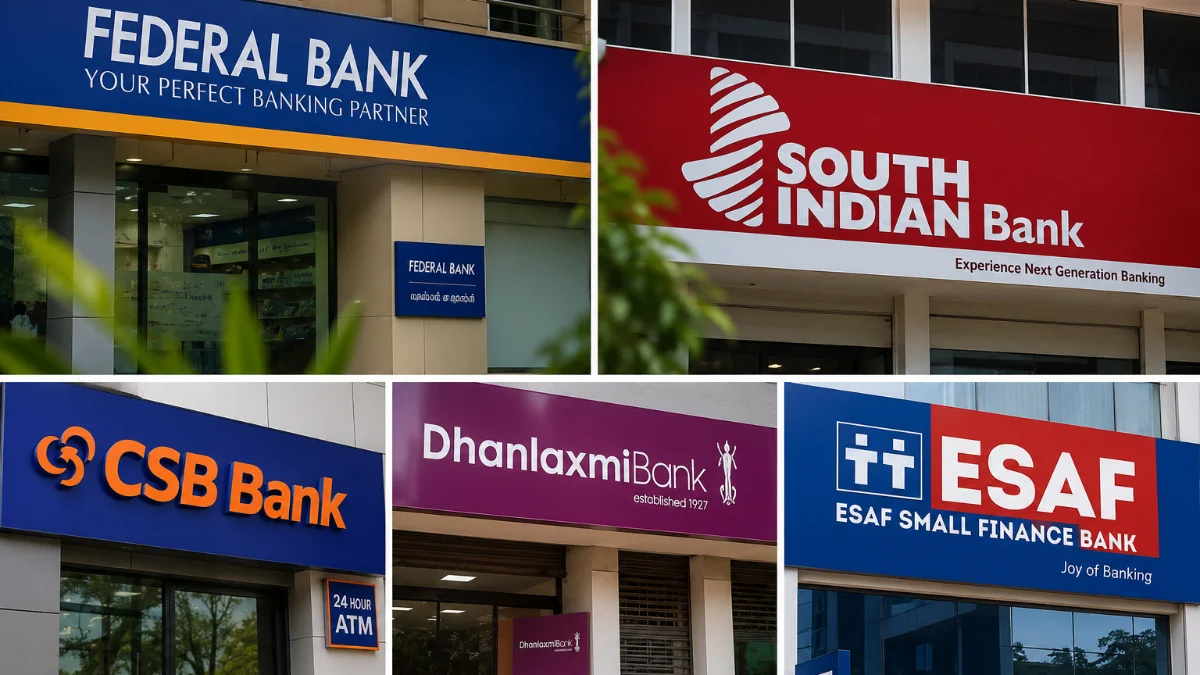
An analysis of five Kerala-origin private banks - Federal Bank, South Indian Bank (SIB), CSB Bank, Dhanlaxmi Bank and ESAF Small Finance Bank - shows that Kerala accounted for between 37 per cent and 75 per cent of their deposits at the end of FY26.
But the banks’ share of their advances ranged from only 18 per cent to 53 per cent.
In other words, every one of the five banks sourced a substantially larger proportion of its deposits in Kerala than the proportion of its advances deployed in the state.
The divergence was widest at ESAF Small Finance Bank. Kerala accounted for 72.9 per cent of its deposits but only 33.5 per cent of its advances, a difference of nearly 39.4 percentage points.
Federal Bank showed a similarly pronounced mismatch, with Kerala accounting for 58.6 per cent of deposits against 26.6 per cent of advances. At South Indian Bank (SIB), the corresponding shares were 62.9 per cent and 31.3 per cent.
The pattern was also evident at Dhanlaxmi Bank, where Kerala accounted for 74.8 per cent of deposits and 52.8 per cent of advances, and at CSB Bank, where the corresponding figures were 37.2 per cent and 17.8 per cent.
Source of funds, not a market for credit
The numbers underline how the Kerala franchise of these banks has become more important as a source of funds than as a destination for credit.
The five banks have progressively expanded their lending footprints beyond their home state, while Kerala remains a particularly important deposit market. This is especially relevant in a state with a large pool of household savings and substantial NRI-linked deposits.
The geographical distribution of the banks' balance sheets shows that Kerala contributes disproportionately to their funding base relative to their lending exposure to the state.
For banks headquartered in Kerala, this has an important strategic implication: the home market can provide a funding advantage even when growth in the loan book increasingly comes from outside the state.
ESAF has the widest divergence
ESAF's numbers stand out among the five banks. Almost three-fourths of its deposits were located in Kerala at the end of FY26, while only about one-third of its gross advances were in the state.
The difference of 39.4 percentage points means Kerala's weight in ESAF's deposit base was more than twice its weight in the bank's advances.
Federal Bank and South Indian Bank also showed gaps of around 32 percentage points each.
Even CSB Bank, which had the smallest divergence among the five, showed a gap of more than 19 percentage points.
The five banks are not identical. Federal and South Indian Bank are much larger, full-service private banks with national footprints, while ESAF is a small finance bank and Dhanlaxmi and CSB have their own regional concentrations.
Yet the same broad pattern appears across all five: Kerala is more important to their deposit mobilisation than to their credit deployment.
That makes the finding more significant than the high credit-deposit ratios (CD ratio) often used to describe Kerala's banking market.
The question, therefore, is not merely whether Kerala has a high CD ratio. It is whether the state's strong deposit mobilisation - including its large NRI-linked savings pool - is helping Kerala-origin banks build balance sheets that increasingly support lending beyond the state.