KOCHI: Mis-selling has long been the insurance industry's Achilles' heel. Regulators now appear to be targeting the incentives that fuel it.
Mis-selling may begin long before a policy is sold; It may begin with the way insurance is sold.
Recent interventions by the Reserve Bank of India (RBI) and the Insurance Regulatory and Development Authority of India (IRDAI) suggest regulators are no longer treating mis-selling, rising commissions, customer complaints and bancassurance practices as isolated issues.
Instead, they appear to be examining a common thread running through them all - the incentive structure that drives insurance distribution.
The RBI, in its latest Financial Stability Report (FSR), warned that commission payouts by private insurers have risen sharply, with commission ratios in the private life insurance sector almost doubling between 2021-22 and 2025-26.
It cautioned that escalating acquisition costs raise the risk of commission-driven mis-selling.
Within weeks, IRDAI Chairman Ajay Seth called for every insurance policy to be traceable to an individual salesperson and argued that policyholders should know the commissions paid on the products they buy.
The regulator has since approved mandatory tagging of authorised sales-persons and indicated broader reforms to the distribution framework.
Viewed together, these developments suggest the focus may be shifting from merely identifying instances of mis-selling to addressing the commercial incentives that could encourage it.
Bancassurnce
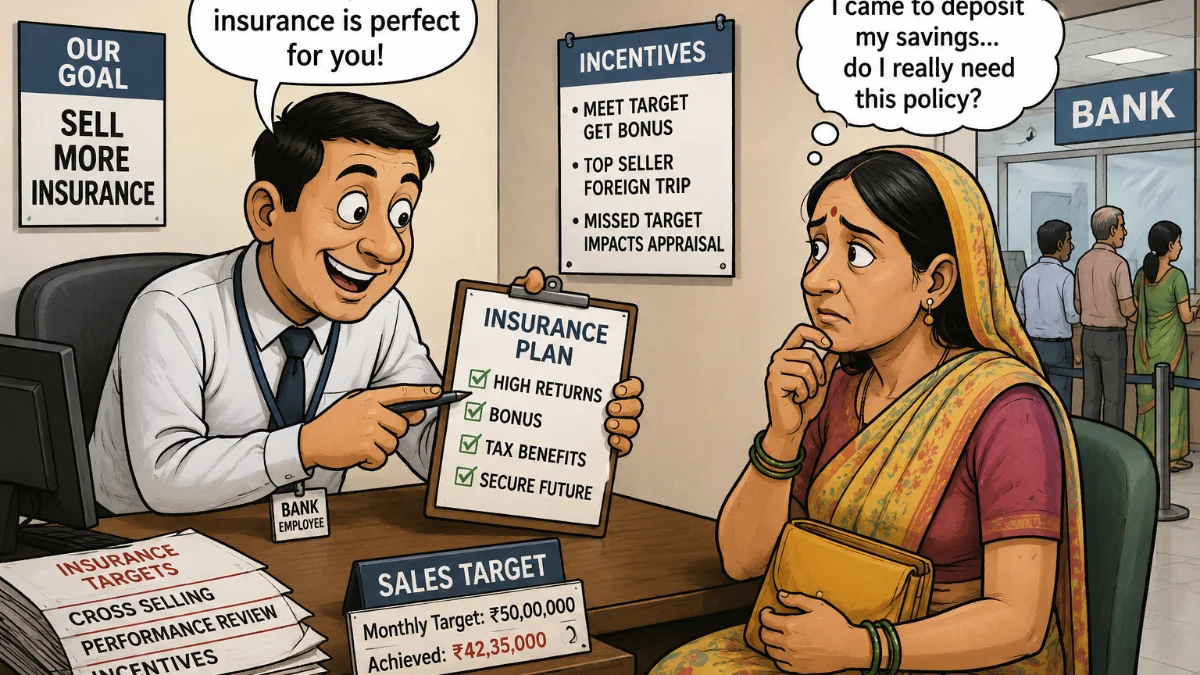
The debate assumes particular significance for bancassurance, one of the country's largest insurance distribution channels. Customers generally walk into a bank to renew a fixed deposit, operate an account or seek a loan - not necessarily to buy insurance. Yet insurance has become an important source of fee income for banks and an important business target within branch networks.
For many bank employees, insurance sales are measured alongside conventional banking responsibilities. Performance assessments, incentive payouts and career progression in many institutions are influenced, to varying degrees, by business targets.
"While banks have robust compliance systems and many policies are sold appropriately, the commercial pressures associated with meeting sales goals can create potential conflicts between sales objectives and product suitability," a bank union leader told businessbenchmark.news.
Incentive structures
The issue is not entirely new. Insurance regulators have, from time to time, taken action against banks over distribution-related deficiencies, while employee unions in parts of the banking sector have protested against what they describe as excessive pressure to meet insurance sales targets. These developments have largely been viewed as separate episodes. The RBI's observations and IRDAI's recent initiatives suggest regulators may now be connecting those dots.
Commission disclosure and mandatory identification of the salesperson improve transparency and accountability. But they may also represent the beginning of a broader regulatory rethink. The larger question is whether disclosure alone can curb mis-selling if the incentive structures that influence product recommendations remain unchanged.
Insurance is ultimately a business of trust.
Regulators now appear to be asking whether that trust can be strengthened not merely by making sales more transparent, but by ensuring that the incentives behind those sales are better aligned with the interests of policyholders.