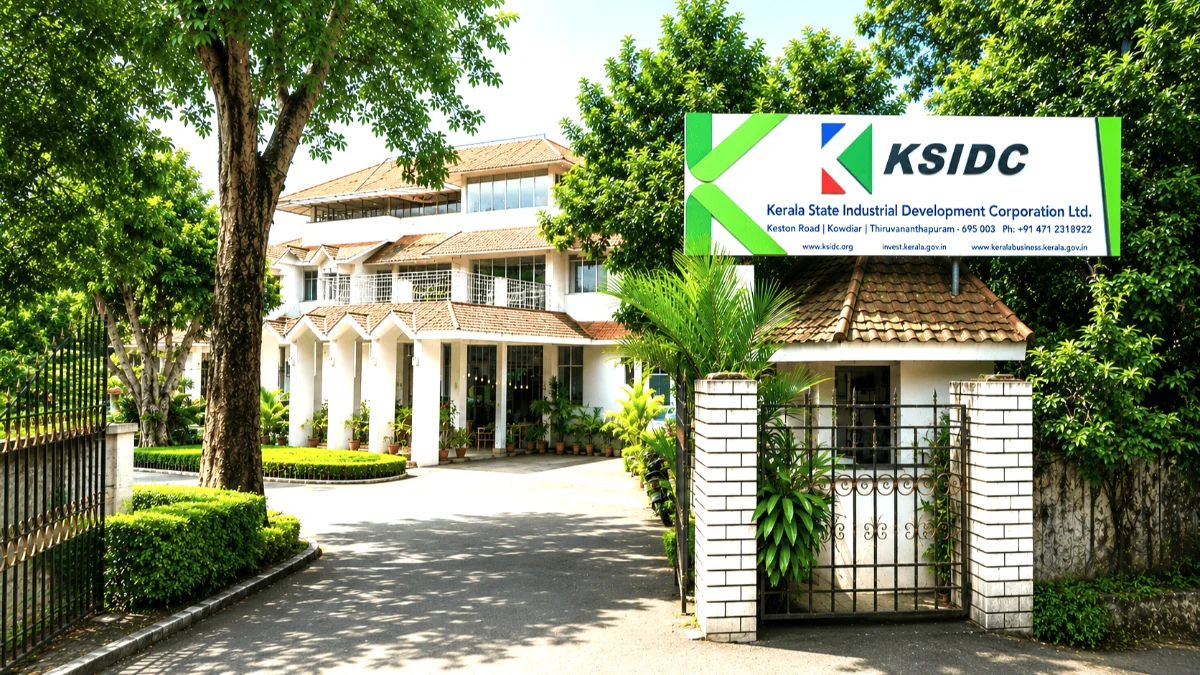
THIRUVANANTHAPURAM: Kerala State Industrial Development Corporation (KSIDC) was set up in 1961 to facilitate and finance medium and large industries in the state.
Over the years, its mandate has expanded beyond project finance to include investment promotion, industrial infrastructure and implementation of several government initiatives. More than six decades after its formation, however, a broader question merits attention: what exactly is KSIDC delivering as Kerala’s industrial-development arm?
The question assumes importance against the backdrop of its latest financial performance. KSIDC’s assets under management fell to Rs1,706.73 crore in FY26 from Rs1,889.36 crore a year earlier, while its profit after tax (PAT) plunged to Rs6.76 crore from Rs52.76 crore. Its return on average assets dropped from 2.65 per cent to just 0.35 per cent.
Asset quality remains another challenge. Gross NPA stood at 18.32 per cent as of March 31, 2026, compared with 20.31 per cent a year earlier. Net NPA, however, improved sharply to 3.90 per cent from 10.51 per cent, helped by accelerated provisioning. The latest assessment says controlling fresh slippages while growing the loan portfolio will remain an important monitorable.
But these numbers alone do not tell the whole story. KSIDC is not a conventional commercial lender whose performance can be judged simply by profitability and asset quality. It was created specifically to support industrial development, including areas where commercial financing may not always be readily available. Its stated functions now include financial assistance, investment promotion, industrial growth centres, industrial parks and implementation of state policy initiatives.
KSIDC mandate
That makes the more pertinent question one of outcomes. How much industrial investment has KSIDC helped create? How much new capacity and employment has its financing and investment activity generated? And how much of its capital is being deployed towards new industrial activity rather than merely supporting existing borrowers and projects?
There is also an important distinction between financial strength and developmental effectiveness. KSIDC had a net worth of Rs1,232.42 crore at the end of FY26, a capital adequacy ratio of 63.91 per cent and gearing of only 0.21 times.
In other words, the corporation is not facing a capital or leverage constraint. The question is how effectively that financial capacity is being converted into industrial-development outcomes.
Its role as an equity investor adds another dimension. KSIDC has investments in companies as part of its broader mandate, meaning its role is not confined to lending. That raises questions about how it selects investments, monitors them and ultimately measures their contribution to Kerala’s industrial objectives.
The transparency of the institution also deserves attention. KSIDC’s latest publicly available annual reports need to be examined alongside its more recent financial numbers to understand the composition of its loan book, investments, recoveries and developmental activity. For a wholly state-owned institution, the public should be able to assess not just its financial performance but also the outcomes generated from the capital entrusted to it.
The issue, therefore, is not whether KSIDC should exist or whether a high NPA ratio by itself indicates failure. The more fundamental question is whether Kerala is getting sufficient industrial-development value from an institution created specifically for that purpose.
After more than six decades, that may be the more important measure of KSIDC — not merely how much it lends, but what that lending and its wider activities have actually delivered for Kerala’s industrial economy.