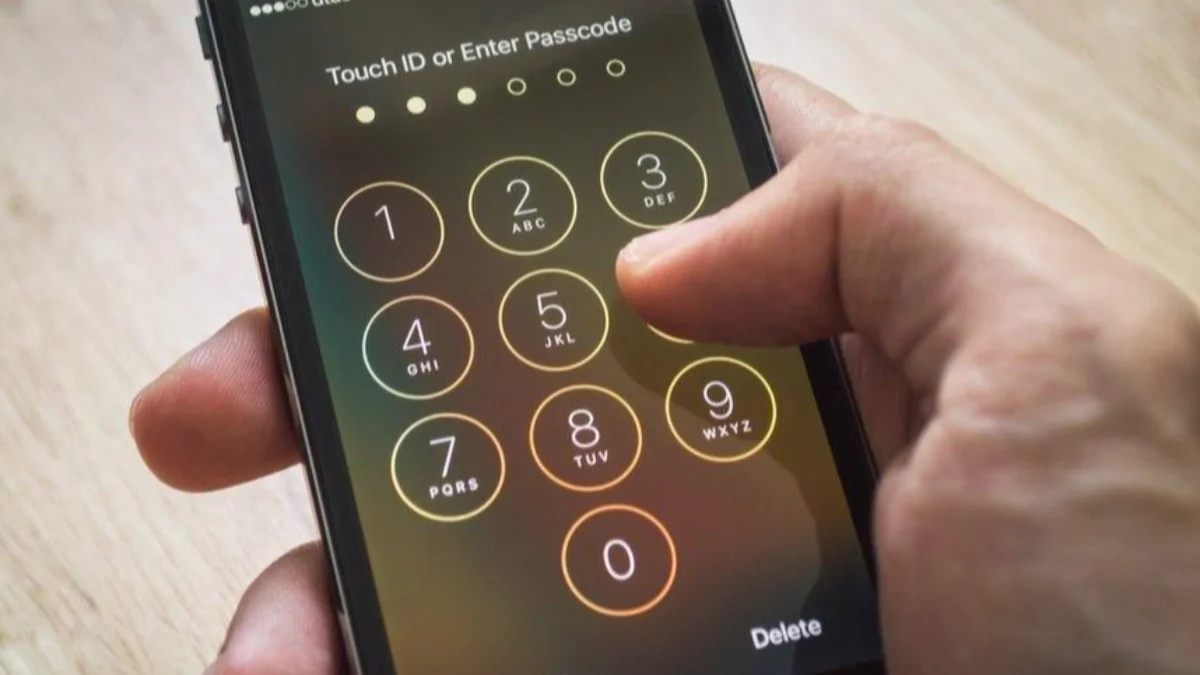
BENGALURU: Passwords are everywhere and nowhere at the same time. We lean on them daily, yet they remain the digital equivalent of a screen door on a submarine — easily kicked in, often left ajar.
They can be guessed by algorithms, phished by a well-crafted email, or leaked in industrial quantities. As a case in point, last month alone 124 million new passwords were quietly added to the Have I Been Pwned database, a staggering figure that barely raises eyebrows anymore.
The lesson is clear: anything you can memorise and type is ultimately something someone else can steal.
Biometrics appears to offer a way out. Why remember a string of characters when your face or fingerprint can serve as the key? The appeal is obvious, and the adoption has been swift. But biometrics carry their own unsettling asterisk: a fingerprint, once lifted and replicated, is compromised for life.
You can reset a password in thirty seconds; you cannot reset the ridges on your thumb. A face scan, too, is a permanent credential walking around in broad daylight, waiting to be captured.
The industry has been hunting for something better — a credential that is hard to copy, easy to reset, and fundamentally alive. A research team at the Singapore University of Technology and Design believes they may have found it in one of the most mundane human acts imaginable: the way you blow air.
Their system, called BlowLive, asks a user to exhale into their smartphone microphone and then treats the resulting acoustic signature as proof of identity. The headline number is compelling: the system correctly identifies the right user 99.56 per cent of the time, and when it pairs breath acoustics with facial recognition data, that figure can climb as high as 100 per cent.
How a breath becomes a key
The core insight behind BlowLive is that no two people breathe quite the same way. The shape of the oral cavity, the force of the diaphragm, the subtle turbulence of air passing over the lips — all of these combine to produce an acoustic signature that is individually distinctive.
What makes this a behavioural trait rather than a purely anatomical one is that it varies from blow to blow, which is both a problem and, counterintuitively, the system's greatest strength.
Intra-user variability normally erodes accuracy. If a biometric system cannot recognise the same person across slightly different attempts, it becomes frustrating at best and useless at worst. BlowLive works around this by deploying a cryptographic technique known as a "fuzzy extractor".
In essence, this mechanism distills a stable, reproducible secret key from noisy, inconsistent input. The math is complex, but the outcome is simple: the system can recognise you even when your blow is not perfectly identical to the last one — and, crucially, it can generate a new key if the old one is ever compromised.
This revocability is the feature that separates BlowLive from the biometrics we use today. A fingerprint is forever. A breath-derived key can be discarded and regenerated as easily as changing a password, except you do not have to remember anything.
The liveness problem, solved by physics
For years, the most stubborn problem in biometric security has been liveness: how does the system know it is looking at a real, living person rather than a photograph, a video, or a silicon mask? The UK's recent struggles with age verification checks have made this painfully clear — a static image or a clip from a video game can sail past a lazy face scanner without resistance.
BlowLive tackles liveness by exploiting the Doppler shift, the same principle of physics that makes an ambulance siren drop in pitch as it races past you.
When a user blows into the microphone, the system measures the frequency shift created by the movement of air. A recording played from a speaker cannot replicate this effect convincingly, because the acoustic properties of moving air differ measurably from those of a stationary speaker cone. The team reports that this mechanism alone achieves 99.42 per cent accuracy in distinguishing a genuine breath from a spoofed one.
Why two signals beat one
BlowLive is not betting everything on breath. The system fuses the blow-acoustic pattern — a behavioural modality — with facial recognition, a physiological one. It is a multi-factor approach, and the logic is sound: a single signal can be faked, but two independent signals, one of which is behavioural and ephemeral, are exponentially harder to counterfeit simultaneously.
This fusion also insulates the system against the growing threat of AI-generated deepfakes. Voice cloning and lip-sync synthesis have advanced to the point where they can deceive unimodal systems with alarming ease.
But generating a realistic face and a realistic breath, synchronised in real time, is a far taller order. The researchers incorporate advanced spectral feature extraction and multimodal fusion techniques to ensure that both halves of the identity check corroborate each other before granting access.
One of the more elegant aspects of BlowLive is what it does not require. There are no dongles, no dedicated fingerprint sensors, no infrared dot projectors beyond what a standard smartphone already offers.
A camera and a microphone are all the hardware needed. A breath is free, it disappears the moment it is made, and it cannot be left behind on a sticky note or discovered scribbled in a notebook.
The study was conducted with only 50 participants, a sample size that invites reasonable skepticism about how well the system would perform at population scale. The authors contend that the underlying signal processing and cryptographic architecture are designed to scale, and that the uniqueness of breath acoustics should hold across far larger datasets.
Still, real-world deployment would demand rigorous testing across diverse demographics, languages, and environmental conditions.
Then there is the simpler, more stubborn question: will anyone actually want to do this? Passwords are a nuisance, but they are a familiar nuisance.
Face unlock works before you even think about it. Blowing at your phone every time you want to check a notification or open a banking app is a behavioural ask that borders on the intimate — and possibly the socially awkward. Imagine doing it on public transport or in a quiet open-plan office.
The friction may be small, but it is not zero, and user tolerance for authentication friction has never been lower.